
Did AI Eliminate Your Brain Breaks?
Have you noticed that the more productive you become with AI, the more mentally exhausted you feel? How much of it could be related to treating your work day like an all-out sprint rather than an endurance race?
Stick with me on this one.
Before AI assistants, most workdays included a mix of mental demands. We spent part of the day solving problems, creating presentations, analyzing information, or making decisions. But we also spent time on lower-intensity tasks such as organizing notes, entering data, or cleaning up reports.
Those routine activities weren’t always enjoyable, but they allowed our brains to shift into a lower gear. The energy and concentration levels needed ebbed and flowed naturally.
As AI joined our team, we began offloading those lower-intensity tasks, concentrating more of our day in the activities that require judgment, creativity, strategic thinking, and decision-making.
The work is often more meaningful, but it is also more mentally demanding.
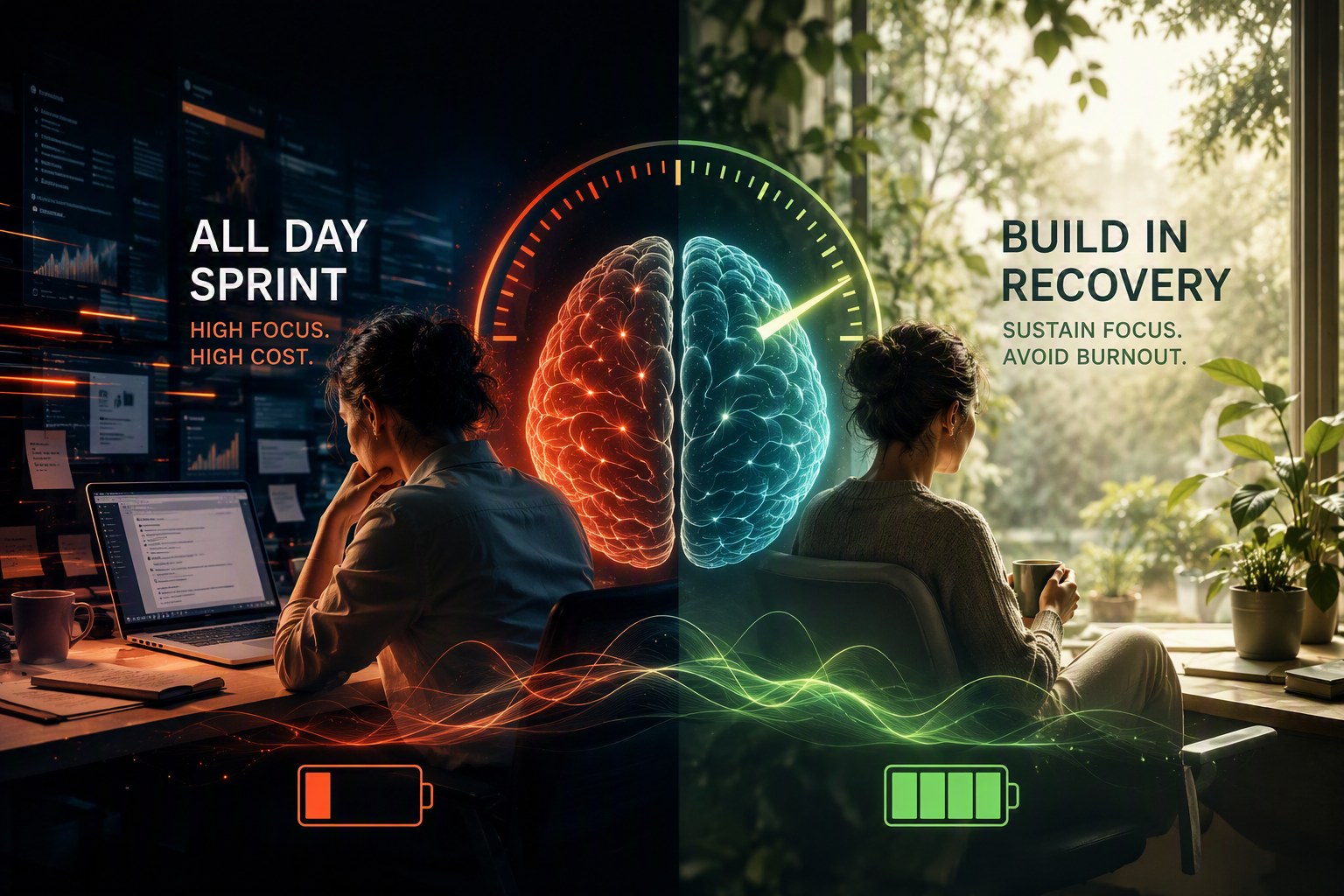
Compare this to a high intensity interval workout (HIIT) for your brain – short periods of intense work coupled with recovery time. Now remove all the recovery segments and you are left with nothing but an all-out sprint.
Many knowledge workers are unintentionally doing exactly that. This is unsustainable. The problem isn’t necessarily that AI is increasing the amount of work. It’s that AI may be increasing the concentration of cognitively demanding work.
If you never let off the proverbial brain gas pedal, burnout becomes much more likely.
The next adaptation may be learning how to keep the productivity gains of AI without leaving ourselves mentally depleted.
What does that look like?
1. Develop Awareness
Pay attention to your cognitive energy throughout the day.
When do you feel sharpest? When does your mental tank run low? Are you taking breaks before you need them, or only after you’re exhausted?
Understanding your own patterns is the first step.
2. Build Recovery Into Your Workday
Treat focused thinking like an interval workout. Schedule blocks of deep work but also schedule deliberate recovery periods afterward.
Recovery doesn’t mean doing nothing. It means shifting to a lower cognitive load. Take a walk. Have a conversation with a colleague. Sit quietly with your coffee. Paint or draw. Let ideas ruminate without actively directing them.
Think of it as putting your brain into Zone 2.
3. Redefine Productivity
AI can help you accomplish more. That doesn’t mean you should continuously operate at maximum intensity.
The goal isn’t to maximize productivity every minute of the day. The goal is to sustain high-quality thinking over the long term. Just as athletes need recovery to perform at their best, knowledge workers need cognitive recovery to maintain creativity, focus, and energy.
AI may be changing how we work. It may also require us to rethink how we recover.
Leave a Reply