
Is work-life balance still relevant?
For decades, work-life balance has been a guiding principle, but its meaning has evolved across generations:
- Boomers valued professional loyalty.
- Gen X focused on structured time division between work and personal life.
- Millennials linked mental health and well-being to productivity.
- Gen Z emphasizes boundaries and holistic wellness.
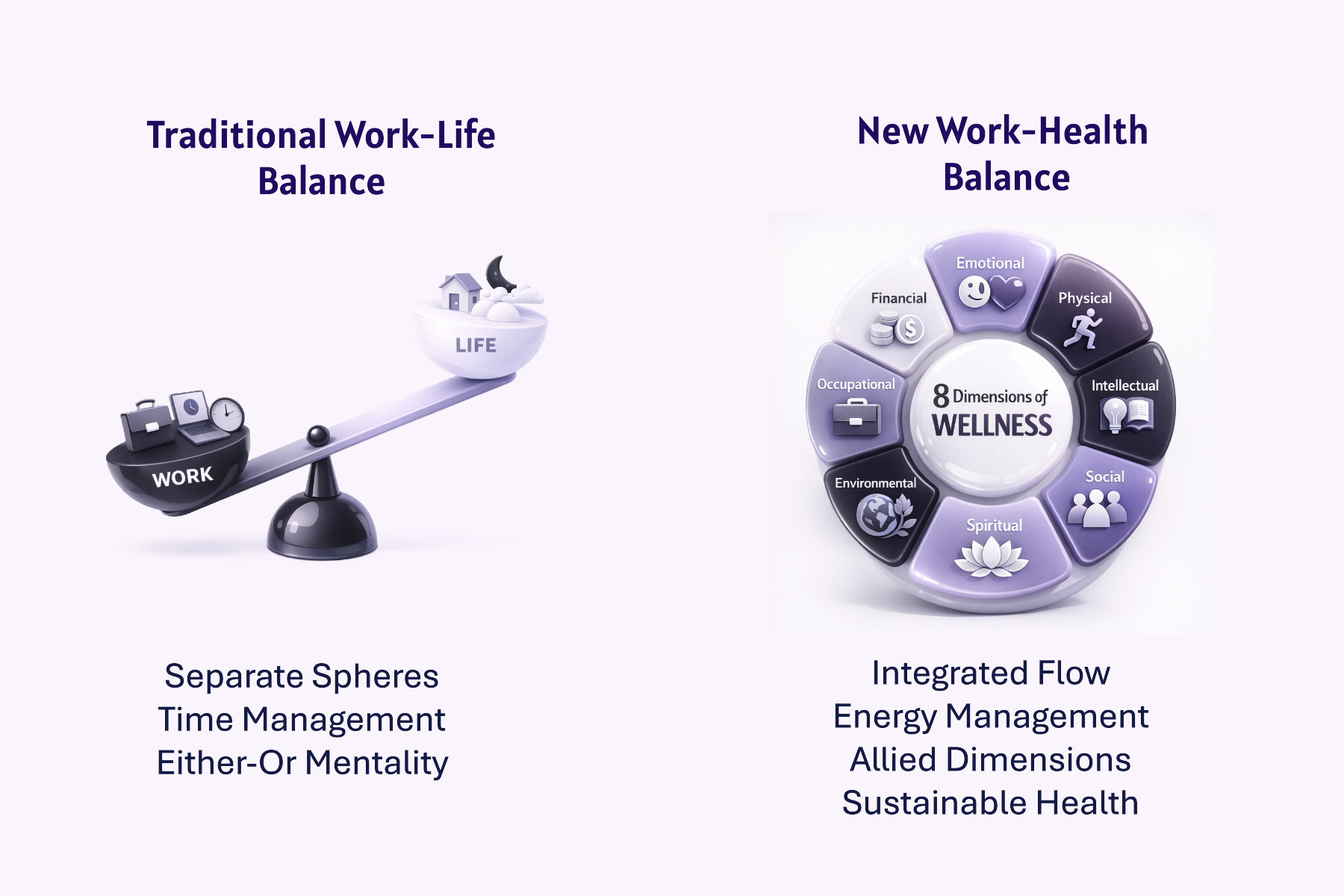
Despite these shifts, the traditional model still frames balance as a time-based metric—how much time is allocated to work versus “life.” This approach is outdated because it overlooks the deeper impact of work and life activities on overall health.
Why a New Model?
As a Gen Xer, the concept of balance was about avoiding burnout while maximizing productivity. But simply preventing burnout does not create healthy workers. Health is multidimensional—physical, mental, emotional, social, financial—and every activity, whether paid work, volunteering, or family time, influences these dimensions.
Stress management is a prime example: unmanaged stress undermines sleep, emotional stability, and physical health. Financial insecurity (linked to work) affects mental well-being and relationships. Everything is interconnected.
The New Paradigm: Work-Health Balance
- Old Model: Balance = splitting time between work and life.
- New Model: Balance = sustaining health across all wellness dimensions, supported by work culture and policies.
Work is not separate from life—it is part of the ecosystem that shapes health. The goal is not just productivity or avoiding burnout but fostering environments and personal practices that promote health rather than undermine it.
Key Principles
- Holistic View: Consider all dimensions of wellness—mental, physical, social, financial, environmental.
- Stress Relationship: Focus on managing stressors, not just stress symptoms.
- Shared Responsibility: Individuals and organizations must align work expectations with health outcomes.
- Integration: Work should support, not compete with, overall well-being.
Bottom Line
Work-life balance as a time metric is obsolete. The future is Work-Health Balance, where success is measured by how well work and life activities collectively sustain health and resilience.
What do you think? Are we ready for this shift?
Leave a Reply